
Learning the Zarabanda with Latinx Poet and Scholar Edgar Garcia

Latinx poet, scholar and University of Chicago professor Edgar Garcia writes from the charged space where history, dream, performance and the Americas collide.
In Skins of Columbus, Garcia spent three months reading Christopher Columbus’ journals before bed, recording the dreams that followed and turning that subconscious fallout into poems, essays and art. The project later found a second life when composer and violinist Keir GoGwilt adapted pieces from the book into The Zarabanda Variations, a collaborative project that pulls Garcia’s poetry off the page and into a soundscape shaped by Indigenous, Spanish, African and Arab influences. In the conversation below, Garcia talks about colonial memory, performance, collaboration and what happens when a poem refuses to stay finished.
Shaylynn Marks: Tell me about Skins of Columbus, and what inspired it.
Edgar Garcia: Skins of Columbus is an inquiry into the colonial subconscious. What that means in practical terms is that for the three months during which Columbus traveled the coast of the Americas in 1492-93, I read his journal entries before going to bed at night. I would think intently on the plot, symbols, images, motives and landscapes to try to make myself dream the colonial subconscious — to see what of the colonial subconscious was entangled in my sleeping mind.
Took notes throughout the night, recorded my dreams, and in the mornings, I wrote the poems, essays, and made the art that became that book. People have asked me, “Why would you do that? Sounds nightmarish.” But my answer is:
I don’t think you become a poet by avoiding the poison of history. It’s your job to swallow the poisons of history and sweat Atlantean gold. If you’re not doing that, then what are you doing?
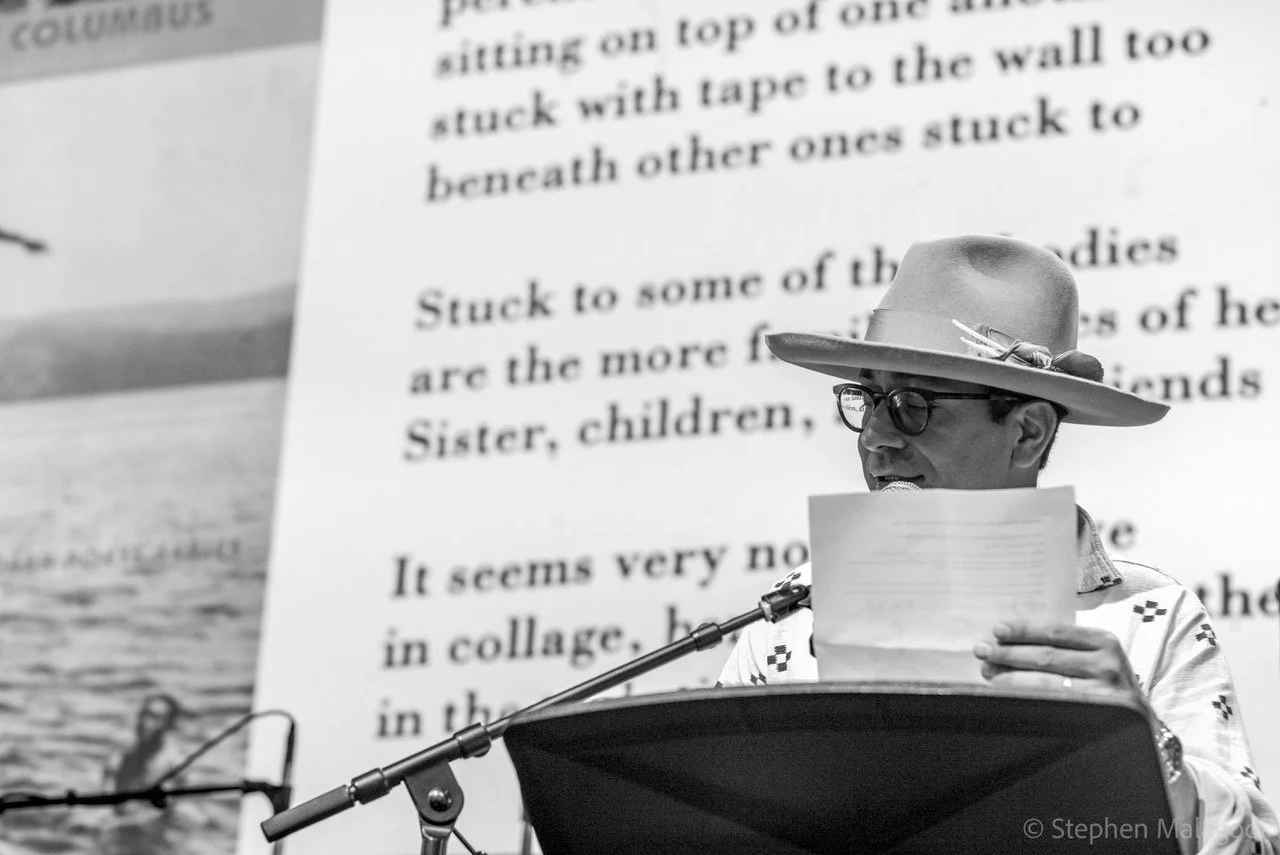
Photography Credit: Stephen Malagondi
SM: What made you want to work performatively, off the page?
EG: I am a poet and a scholar of the hemispheric and Indigenous cultures of the Americas, trying to foreground what has not always been thought of as literature and culture for various historical and intellectual reasons: khipu, or knot writing; dreams, dream practices, ceremonial goldwork, creation stories like the Popol Vuh, Indigenous song traditions like Cantares Mexicanos, and most recently, the Indigenous legacies embedded in what we call Baroque art.
The longer you look at something, the more you end up looking like it. I ended up starting to look like it, to do it, to try to bring more orality into my poetry. I started by doing a little bit of actor training because I became fascinated by what the body can do in a poetry reading, in a scene of oral performance. I wanted to be able to do more with my body and not just be a mouth in a room — to bring the fullness of my physical presence into my readings.
I came to realize that poetry always has to address an actual person in the room. It can’t be an idea, or an idea of a group of people. It actually has to be a person in the room. That opened up my poetry to the sense that I was always having to talk to someone, whether living or dead, real or fictional, human or animal. It couldn’t be an abstraction. It had to be a form of theater.
SM: How did you and Keir navigate the collaboration process?
EG: We realized we had a lot of overlapping interests. He invited me to come out and view one of the earliest performances of the piece at the Clark Art Institute in Massachusetts. He and the other musicians were part of an extended residency out there, and they had a performance of a very preliminary version of the work.
I flew with my daughter, who was maybe seven at the time, and it was fantastic. It was incredible to see what Keir had done with the Baroque soundscape of the Columbus dream journals, introducing the Arab, Hispanic and Indigenous elements into what the zarabanda originally was.
At some point, Keir invited me to come on stage and asked if I would read some of the poems. My daughter came on stage, too. She made animal sounds. There’s got to be a recording of her making these awesome dog sounds in the background of one of those very early versions of the piece.
The connection could not have been more powerful or more natural between myself and the musicians. They were there for it. I was there for it — for the both structured and improvisatory quality of this musical work.
After that, because it was so powerful, we decided to deepen the collaboration and try to have me come whenever the group performed. The two intellectual visions have now collided and integrated: the poetry, the art, the writing — the music with all of its own internal collisions. It all came together in this album and this chapbook.
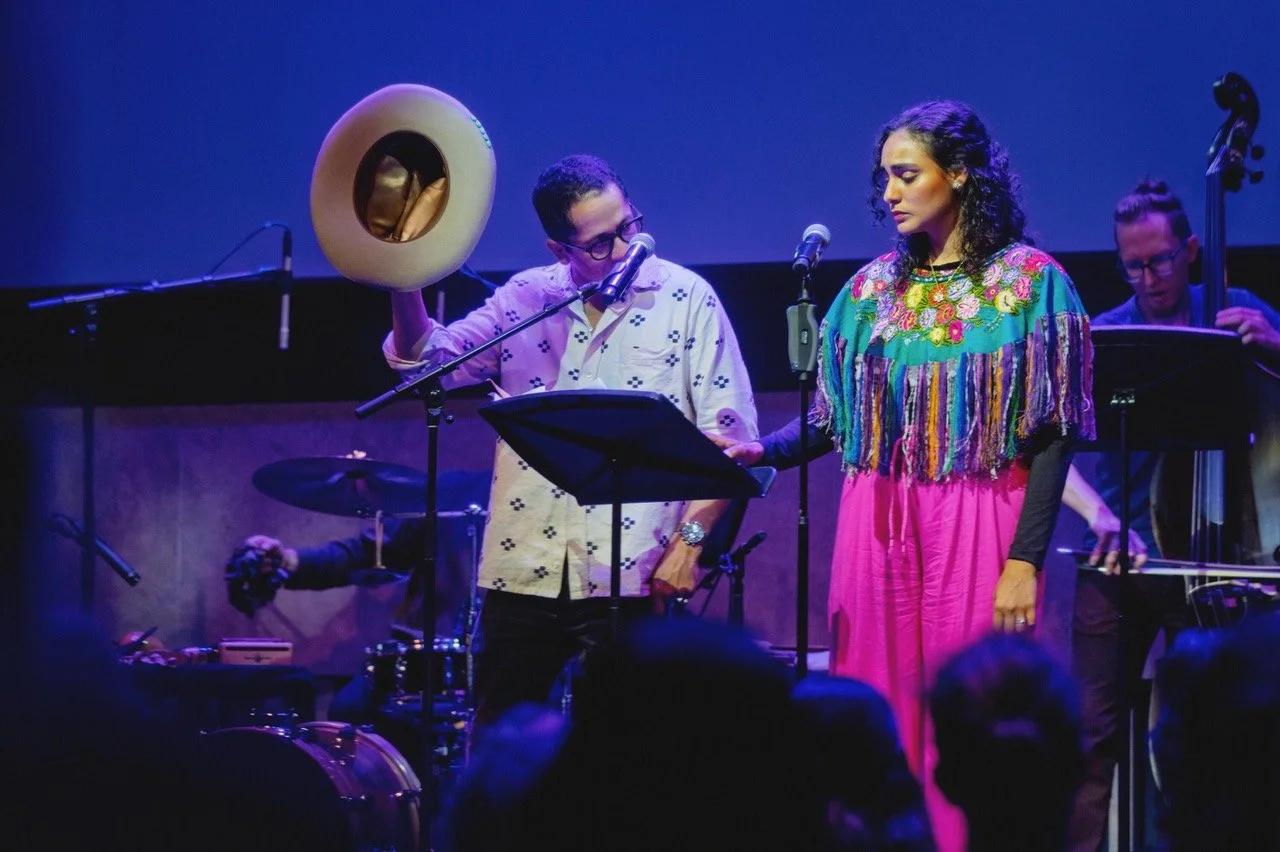
Photography Credit: Lawrence Sumulong
SM: What made you decide on the zarabanda?
EG: The dance! It is both structured and improvisatory. The zarabanda is a mixture of the soundscape of the Americas: European, Indigenous, Hispanic, African and Arab, all coming together and colliding and pulling apart at times, then coming together again. Just like the social history of the Americas is known to do.
“For me, what the Baroque means is the crisis of contradiction in the Americas. I believe the Baroque begins in 1492, and so this musical object is a manifestation of that social history, but also a critical and creative interrogation of its legacies.”
SM: The poems were already published, but with this collaboration, how did you turn back to the page? Did the Skins of Columbus poems change at all in this chapbook?
EG: One thing I have learned in my own intellectual journey is that a poem is never really done. This project has sort of rewritten all those poems. It prompted me to rewrite them both intellectually, but also spiritually, by way of their performance.
Those performances can go back and rewrite the poem, even if the poem on the page doesn’t change. In that way, Keir’s project has totally rewritten Skins of Columbus. He gave it the soundscape that I think maybe it was searching for or didn’t know it needed.
It has been a collaboration off the page — a collaboration of music and voice. Mariana, who is the singer, gives it a whole other dimension of voice that I can’t. I can do some things, but she gives it this whole other dimension.
SM: Many of the poems are titled by dates. What was the intentionality behind that?
EG: The dates are the dates of the journal entries for Christopher Columbus. The rationale behind not titling the poems and having them be only dates is to document the very literal and actual process of the creation of the poems, which was a nightly dream journal of putting Columbus into the processing unit that is my brain, my sleeping consciousness, and seeing what came out on the other end.
A large part of the book ended up being about my family’s own migration histories through Central America — Nicaragua, El Salvador, Guatemala — and then to the United States in the ’70s and ’80s. In retrospect, it makes so much sense to me why the journals of Christopher Columbus would have evoked such intense dreaming about migration histories. It is a catalyst effect of migration in the Americas that preceded colonialism, but that also is animated by colonialism.
Of course, because my brain is as wild as anyone else’s and not just a computer, other elements beyond the mirror of Christopher Columbus’ journals came up in the writing.
“I didn’t editorialize it. I wanted an honest documentation of what I had dreamt, because maybe there were things in there that, in that moment, I was not able to perceive.”

SM: The book also feels cyclical, like we keep returning to the same historical problems.
EG: This is one thing I’ve come to realize about the Baroque: the structure of time in the Baroque is not linear. It doesn’t move forward. There is no progress in the Baroque; there is only repetition.
Baroque time is repeated, therefore its obsession with things like mirrors, undulations, and excessive ornamental repetition. It has no sense of movement forward. That explains a lot about the way in which we keep coming back to the same historical problems in the Americas. It’s a temporal structure of repetition.
I also believe in underworlds. One amazing thing about underworlds is that we are already always there. The question is: What are you going to take out of it?
We live in the world of the dead. I didn’t build this house; whoever built this house is probably dead. Whoever built my furniture is dead. This language that I’m talking to you in is not a language that I created. These words are the words of the dead.
So, I live in an underworld. The question is: What is the sacred teaching, the thing that I’m supposed to emerge from this with and take up into the upper world?
SM: Because dreaming is such a major part of the work, do you use other spiritual practices in your art?
EG: I think the way I want to answer it is yes. I’m from Los Angeles, California, so by nature, I believe in everything that’s valid.
I love to make my imagination and my intellectual curiosity available to just about everything that is. If there is a practice that has to do with the possibility of teasing out some corner of my consciousness, or the impersonal consciousness, then I will try it and see where it takes me.
I have done experiments with remote viewing and astral projection. I have had experiences that I cannot explain, but that I have written. I have experienced the presence of other beings in my sleeping mind in a non-metaphorical, non-symbolic way — actual beings.
In a nutshell, yes, I am a poet. That is what a poet does with their soul, their spirit, their mind. You open it up. As Shelley said, “Your job is to be the antenna of the cosmos, the antenna of the universe.” I want to have a really high-functioning antenna to pick up the signals rushing across every day.
SM: What advice would you give writers interested in multidisciplinary collaborations?
EG: Collaboration is an art of listening and tuning into another person’s creative and intellectual vision. That’s not always easy. It has been really easy with Keir because he’s amazing, but people have different barometers, different thermometers, intellectually and creatively. It requires a lot of listening, tuning in and letting go.
The Zarabana Variations will be released on August 7, 2026. You can pre-order it here.