
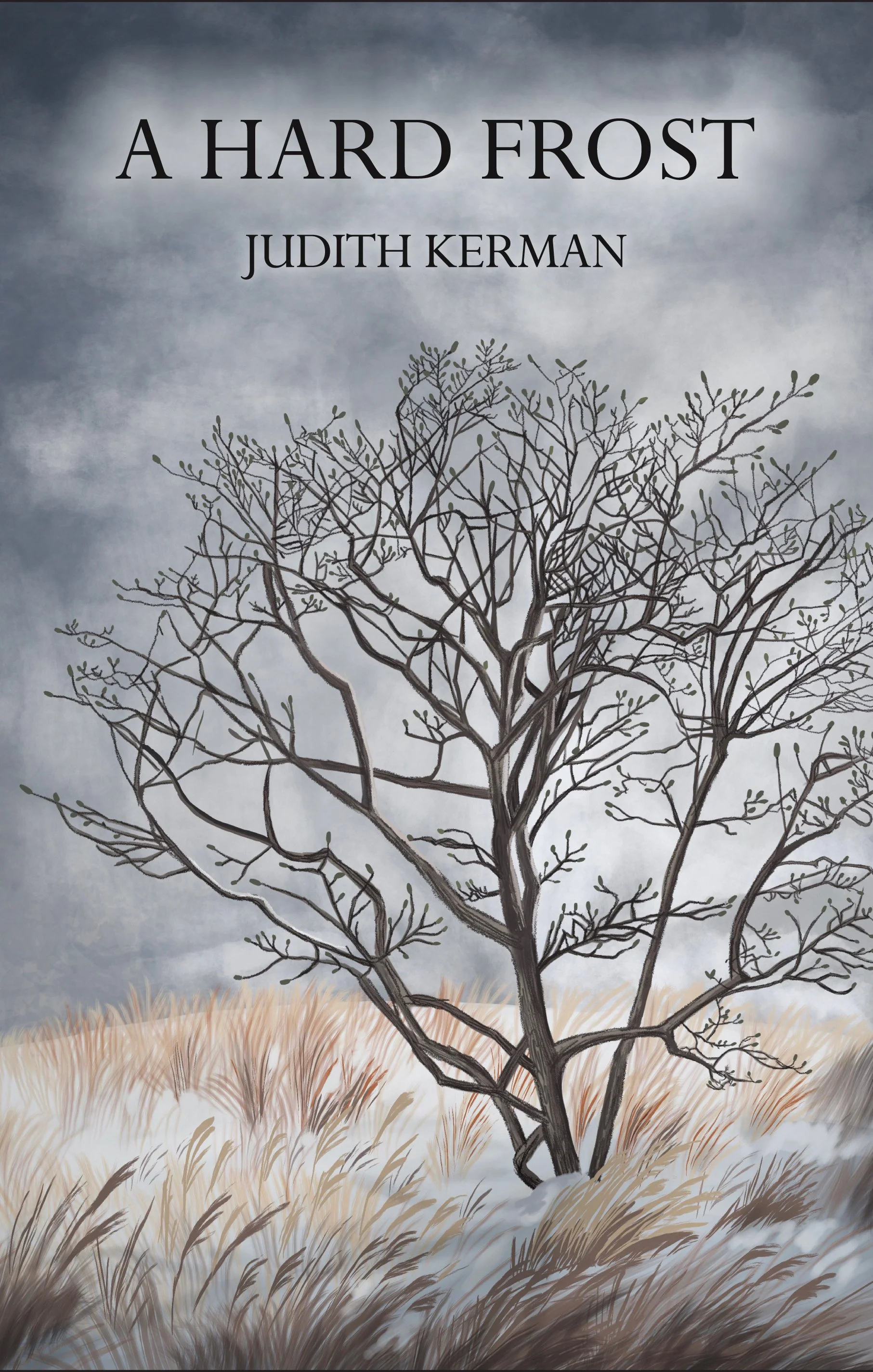
The Iron in My Blood: Judith Kerman’s A Hard Frost
I look at the sky /
and feel how far /
the light has come. /
I stand on stone, / knowing it was fire. /
The iron in the stone /
is the iron in my blood.
—”Palm of Seeking,” Judith Kerman
By Elizabeth Ambos
Teacher, publisher, editor, community organizer, translator, science fiction critic, singer, performer, crafter, and of course, poet: Judith Kerman’s multi-faceted life weaves together many bright strands. In her new book of poems, A Hard Frost, Kerman provides us with a meticulously crafted work that unveils her reckoning with age, pain and disability. Her new territories of loss, and slow erosion of the familiar and dear are balanced by her clear-eyed assessment of life’s small joys, her wry humor, her strength and her spiritual connections to nature. The beginning quote from “Psalm of Seeking” expresses her affinity with the earth and her strength: she stands on stone and she is as strong as iron. Her wry humor and matter-of-fact approach to her body’s accrued damages, from major operations to cat claws, comes through in poems like “Scars,” graced with musicality and precise imagery:
“My body is a world
that has been mined.
I count my scars:
hysterectomy a vertical valley,
hands and forearms creased with cat scratches,
the ladder of stitches covering a steel pin”
or as we read in “My Body and I,” in which she uses dark humor to cope:
“My choices were
distance or pain.
I’ve been happiest
when we aren’t
on speaking terms.”
Unlike Dylan Thomas, she does not furiously rail against “the dying of the light.” Instead, she navigates each day with perceptive purpose and persistent fortitude, as in “Brigade”:
“We push and limp, / pump and lift at the gym. / By night we dream / of storming the beaches.”
One of the most satisfying aspects of this book is its intricate design. The book’s five sections — Threat, Gimp, Antique, Perception, Persistence — present cardinal points for Kerman’s life transitions, as she reflects on the challenges and rewards associated with approaching sundown. In Threat, the stage is set as we are given glimpses of Kerman’s life: her childhood, parents, friends, cat, woodstove, cherished pottery and the like. There is a sense of lurking menace, however, even in the idyllic setting of the opening poem, “Magnolia,” which also includes the book’s title:
“It holds its velvet buds
into the cold air, rabbits’ feet,
like the game my mother taught me…
…Some years ago,
the night after it bloomed,
we had a hard frost.
Now I watch through the pane and fret”
The two center sections, Gimp and Antique, offer glimpses of Kerman’s life as a not-so-patient patient (“Trying to Sleep”) and then as someone with reduced mobility, suddenly realizing that the world is often uncaring of those with disabilities (“Disabled”). In “Old,” one of six list poems Kerman inserts at various points in the book, she offers a range of dictionary entries explaining the term, often to humorous effect:
“Creaky in the joints.
When you go up the stairs,
the wood groans.
You also hear your knees.”
In the poems grouped in Perception, she examines daunting aspects of her new physicality (“Curse”, “Seeing My Heart”) and plays with an array of personas. In “Reorienting,” she’s her house:
“Over the years, the house / became my skin… The rooms I sacrificed / for the new apartment / twinge like lost limbs.” In “False Face” she avers that she collects masks “…from a dozen cultures, / scares some people. They see / devils. I see myself, / always playing hide-and-seek.”
The final destination in the book’s journey is a spiritual threshold: not only to that undiscovered country that awaits all, but to finding clarity and strength of purpose in latter days. As Kerman writes in “Stargazing,” the first poem in the Persistence section:
“I want a misty field
above my head in the dark,
so many I can’t name
the constellations,
large grains and small,
a scatter like kosher salt
spilled on a black table.
Shine on me, stars.
Take me where everything
becomes clear.”
In her poem “Orrery,” she asks us to “imagine the sky as apparatus, / the planets swinging, / each in its direction, at its speed” and “invites us to see / as God sees, to hold the whole thing / in sight and mind, / own it.”
This holistic philosophy, this urge to interrogate life as a complex web of interconnections; to link one’s life and the earth and solar systems; to oscillate between approaching and distancing oneself from others, and from one’s own looming mortality; are at the heart of Kerman’s work.
When I read Kerman’s poems, I am reminded of Audre Lorde’s poetry, particularly one of Lorde’s final poems, “Today Is Not the Day.” In this piece, Lorde acknowledges her mortality and the leave-taking that will take place in the future — but not at present — not thisday. Instead, Lorde offers a strong and serene vision:
“This could be the day.
I could slip anchor and wander
to the end of the jetty
uncoil into the waters
a vessel of light moonglade
ride the freshets to sundown”
The final three poems: “Psalm of Seeking,” “Standing Stone,” and “Thinking about my funeral,” bring us to the beginning of Judith Kerman’s next chapter, illumined by spiritual purpose, and seemingly at peace with what is still to come:
“Part of me wants to see
what is coming;
part of me is glad
I’ll be gone.”
“I’ve heard that forests
communicate through their roots.
They are writing Torah.
I will join them.”
For those of us dealing with our own fragile bodies, and/or caring for someone who is experiencing the challenges of the aging process, this inspiring collection of powerful and well-crafted poems depicts the daily exasperations and drolleries of a trammeled existence, while also offering us humor, courage, and camaraderie.
As I burrowed deep into A Hard Frost, I murmured in recognition, “Judith Kerman is a vessel of light, riding the freshets to sundown.”
And her shining light travels far, indeed.
A Hard Frost is now available for purchase through Broadstone Books. You can purchase a print copy here.
About the Writer
Elizabeth Ambos writes and lives in Washington, DC. She is currently working on her MFA in Creative Writing at Hood College, and serves as poetry editor for Pergola Literary Magazine. She is the author of the chapbook, Smoked Glass Lens, just released from dancing girl press. A finalist in Naugatuck River Review’s 17th annual narrative poetry contest, she has also been published recently in Tangled Locks Journal, Please See Me, Dos Gatos Press, and Cagibi.
@be_th678 | Ambos’ latest chapbook